Rubber duck debugging never worked for me, at least not when using actual rubber ducks or other inanimate objects.
Turns out this blog helps wonderfully, because the added pressure of someone reading this someday makes me articulate my ideas better and therefore develop a better understanding myself.
What to write about first? … What about the game I’m currently making? … Maybe the struggles with my autism? … That one cool procedural generation algorithm I saw a while back? … Maybe the duality of wanting people to see my creations… but also please don’t observe anything I make.
Have you ever felt unsure about whether to rate something a 6/10, a 7/10 or an 8/10? It’s hard because there is no correct answer, there’s many ways to reason about it and there’s just too many numbers.
The more options you give a brain, the harder it gets to pick between them. In the case of ratings we only have 10 options. What happens if we have to pick between 20, 100 or even 1000?
That’s the problem I am running into with my Steam library right now. Approaching 500 games, it becomes a huge task to make a choice each time I open Steam.
In fact my brain refuses to consider all of them and only ever considers my most recent purchases. It does this fully automatically. To pick something older I need to force myself, even if it’s one of my favorite games of all time.
This trait of my brain reduces the choices to 10-20, but just like with rating something, this is not enough to make a choice. I need some way of reducing the choices further, and the way I’m going to do this is inspired by Steam’s review system.
Steam’s review system is purely a binary choice: Did I like this? Yes/No. Most games in my library easily fall into one of those 2 categories. It loses some nuance but it makes the choice incredibly simple. If you want to add nuance you can add some text to your review.
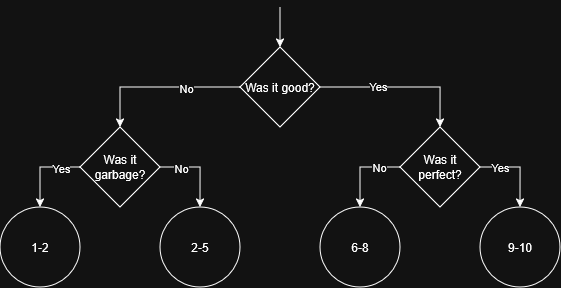
So what if I could apply this to every choice in life? Not every choice has just 2 options, but if the options can be split up into groups, it can be reduced to a series of yes/no questions. My brain already does this subconsciously for rating something:
So my current way of trying to combat choice paralysis is trying to split every choice into a series of yes/no questions. For games this isn’t too hard, but for more difficult open-ended questions this is a lot tougher.